
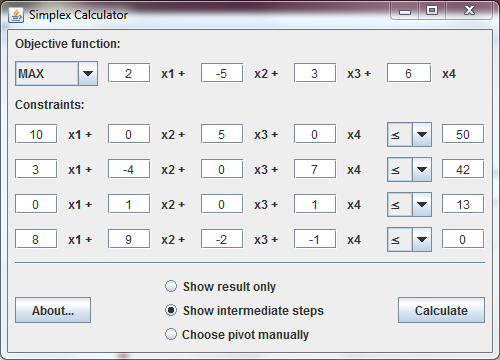
Linear programming (LP) is one of the most important optimization tools used today in fields ranging from data science and engineering to economics, logistics, and operations research. Yet despite its importance, the process of solving LP problems manually—especially using the simplex algorithm—can be complex, tedious, and prone to mistakes. Students often struggle with the calculations, engineers may find it time-consuming, and researchers frequently need quick verification of results.
Fortunately, free online simplex calculators have transformed how we approach LP problems. These automated tools allow anyone—beginners, professionals, or educators—to solve linear programming problems instantly, accurately, and with step-by-step explanations. In this detailed article, we’ll explore exactly what the simplex algorithm is, why online calculators are essential, and how tools like the FujiBit Simplex Method Calculator make solving LP equations faster and more intuitive than ever.

What Exactly Is the Simplex Algorithm?
The simplex algorithm is a powerful mathematical procedure created by American mathematician George Dantzig in 1947. Before this invention, optimizing a large system of linear equations was nearly impossible for real-world applications. The simplex method changed everything—it introduced a systematic way to navigate the feasible region of an LP problem and identify the best solution that satisfies all constraints.
The algorithm works by moving from one “corner point” of the feasible region to another—each one representing a possible solution. Instead of checking every point (which would be impractical), the simplex method cleverly selects only those movements that increase the objective function (in maximization problems) or decrease it (in minimization problems). This makes it incredibly efficient, even for large-scale calculations.
Where Is the Simplex Algorithm Used?
Linear programming and the simplex algorithm have applications across countless industries. Some of the most common examples include:
- Manufacturing: Minimizing production costs or maximizing output using limited materials.
- Transportation: Determining the least expensive distribution routes.
- Agriculture: Optimizing crop distribution based on land, labor, and fertilizer.
- Supply Chain: Allocating warehouse resources for maximum efficiency.
- Finance: Managing investment portfolios under risk constraints.
- Data Science: Feature selection, optimization models, and machine learning pipelines.
- Workforce Management: Scheduling employees to minimize costs while meeting workloads.
If a problem involves linear relationships, limited resources, and a measurable goal, chances are the simplex algorithm can solve it.
Why Solving Simplex Problems by Hand Is Difficult
While the simplex algorithm is elegant, solving LP problems manually often becomes overwhelming. The traditional approach includes:
- Setting up the objective function
- Adding slack or surplus variables
- Creating augmented matrices (tableaus)
- Performing row operations
- Checking pivot elements
- Repeating calculations until the optimal condition is reached
Even a simple two-variable problem can take time and is extremely prone to arithmetic errors. For larger problems with many constraints, manual calculation becomes nearly impossible without a mistake. This is why online calculators are invaluable.
Why Use a Simplex Calculator Instead of Manual Calculation?
A simplex calculator automates the entire process in seconds. Instead of spending hours performing repetitive steps, users can instantly generate:
- The initial simplex tableau
- Each iteration with pivot operations
- The direction of optimization
- Slack and artificial variable handling
- The final optimal solution
Here are the top benefits:
✔️ Speed
What normally takes 20–30 minutes to compute manually is solved instantly.
✔️ Accuracy
All arithmetic is handled automatically, reducing the risk of errors.
✔️ Step-by-step processing
Many calculators—like the FujiBit tool—show every tableau transformation, helping learners clearly understand the solution.
✔️ Easy data entry
You only need to input coefficients; the tool handles the rest.
✔️ Works for both maximization and minimization
No need to manually convert one into the other.
✔️ Zero installation
Runs in any browser—no software or downloads required.
For students, educators, engineers, and researchers, a simplex calculator improves both efficiency and understanding.
Introducing the FujiBit Simplex Method Calculator
Among the various online LP solvers available, the Simplex Method Calculator by FujiBit stands out for being simple, fast, accurate, and completely free. Whether you’re learning linear programming for the first time or solving a complex optimization problem for work, this tool offers everything you need.
Key Features of the FujiBit Simplex Calculator
- Clean and beginner-friendly interface
- Supports any number of variables and constraints
- Handles maximization and minimization
- Provides detailed step-by-step tableaus
- Automatically adds slack, surplus, and artificial variables
- Generates the optimal solution with full interpretation
- Works on all devices—PC, tablet, or phone
Because it explains every step, teachers often use it for classroom demonstrations, and students love it because it acts like a personal LP tutor.
How Does the FujiBit Calculator Work? (Simple Walkthrough)
Using the calculator is straightforward:
- Select the number of variables
- Select the number of constraints
- Pick Maximize or Minimize
- Enter the coefficients of your objective function
- Enter each constraint’s values
- Click Solve
That’s it!
The tool instantly builds the simplex tableaus and gives you:
- Initial tableau
- Pivot operations
- Intermediate results
- Final optimal solution
- Values of variables
- Maximum or minimum value of the objective function
It even indicates if a problem has no solution, unbounded solutions, or infeasible constraints.
Example: Solving a Maximization Problem Using the Calculator
Let’s walk through a simple example to show how easy it is.
Problem:
Maximize
Z=3×1+2x2Z = 3x_1 + 2x_2Z=3×1+2×2
Subject to:
x1+x2≤4x_1 + x_2 \le 4 x1+x2≤4 x1≤2x_1 \le 2 x1≤2 x2≤3x_2 \le 3 x2≤3 x1,x2≥0x_1, x_2 \ge 0 x1,x2≥0
Solution Using FujiBit:
Just input the above values into the calculator interface and click Solve. Within seconds, it provides:
- The entire simplex tableau series
- The pivot decisions
- The optimal variable values
- The maximum value of Z
This simple example helps demonstrate how much time and effort the tool saves, especially when problems become more complicated.
Understanding What the Simplex Calculator Actually Does Behind the Scenes
While the calculator appears to solve everything instantly, it’s performing a series of mathematical steps:
- Converts inequalities into equations by adding slack or surplus variables
- Constructs the initial simplex tableau
- Identifies pivot columns (entering variables)
- Identifies pivot rows (leaving variables)
- Performs elementary row operations
- Iterates until no more improvements can be made
These are the exact steps required to solve an LP problem manually. The calculator automates them flawlessly.
When Should You Use the Simplex Method?
The simplex algorithm is ideal when:
- Your objective and constraints are linear
- You have two or more decision variables
- You want the most optimal (maximum/minimum) answer
- You are working with limited resources
- You want to solve a real-world optimization challenge
It’s widely used in:
- Operations research
- Logistics and supply chain
- Production and manufacturing
- Business decision making
- Transportation planning
- Profit and cost optimization
- Workforce scheduling
If your task involves maximizing output or minimizing cost, the simplex method is your friend.
Benefits of Using Online LP Solvers in Education
Students studying optimization, operations research, or decision science often find simplex calculations difficult. Online calculators help them:
- Understand concepts more clearly
- Verify assignments instantly
- Visualize how each tableau leads to the next
- Focus on learning instead of arithmetic
- Experiment with many variations of a problem
Educators benefit too—demonstrating the simplex method becomes faster and more interactive in the classroom.
How Online Calculators Improve Productivity for Professionals
Engineers, analysts, data scientists, and logistics managers have to solve LP problems frequently. An online simplex calculator saves them:
- Time—solutions come instantly
- Energy—no need for manual tableaus
- Resources—no software licenses required
- Stress—accurate results every time
Companies use LP solvers for:
- Cost minimization
- Resource allocation
- Production planning
- Supply chain modeling
- Budget optimization
- Capacity planning
In these scenarios, the ability to get accurate results in seconds is invaluable.
The Simplex Method vs. Other Optimization Methods
It’s worth noting how the simplex method compares with other algorithms.
✔️ Simplex vs. Graphical Method
The graphical method works only for two-variable problems.
Simplex works for any number of variables.
✔️ Simplex vs. Interior Point Methods
Interior point methods are powerful for very large problems, but simplex remains easier to understand and implement.
✔️ Simplex vs. Software-Based Solvers
Tools like MATLAB, LINGO, or Excel Solver require installation or paid licenses.
Simplex calculators work instantly in any browser with no cost.
This makes the simplex method the most accessible and versatile optimization tool for most users.
Common Mistakes Avoided by Using a Calculator
When solving manually, people commonly make errors such as:
- Incorrectly converting constraints
- Forgetting slack variables
- Choosing the wrong pivot
- Miscalculating row operations
- Ending iterations too early
Online calculators eliminate all these mistakes and deliver the correct results every time.
Are Online Simplex Calculators Always Accurate?
Yes—if they are built correctly. The FujiBit Simplex Calculator, for example, follows the mathematical rules of the simplex method flawlessly. Additionally:
- All calculations are automated
- Intermediate steps are displayed for verification
- The tool handles various LP variations
- It catches exceptions like unbounded or infeasible solutions
This reliability makes the tool trustworthy for academic and professional use.
Final Thoughts: Why You Should Use a Free Simplex Algorithm Calculator Today
The simplex algorithm continues to be one of the most powerful and reliable methods for solving linear programming problems. Whether you’re optimizing resources, reducing costs, or maximizing output, this method provides a clear, structured path to the best possible solution. However, manually solving LP problems can be time-consuming, complex, and prone to errors—especially for beginners or professionals working under time pressure.
That’s why tools like the Free Simplex Algorithm Calculator by FujiBit have become essential. This online solver helps you understand linear programming more deeply, verify your manual solutions instantly, and save valuable time by automating all simplex steps with perfect accuracy. It’s fast, intuitive, beginner-friendly, and accessible from any device, making it the ideal companion for students, researchers, and engineers.
If you’re serious about mastering optimization or simply need a dependable way to solve LP problems quickly and correctly, the Free Simplex Algorithm Calculator by FujiBit is one of the best tools you can use today.
