
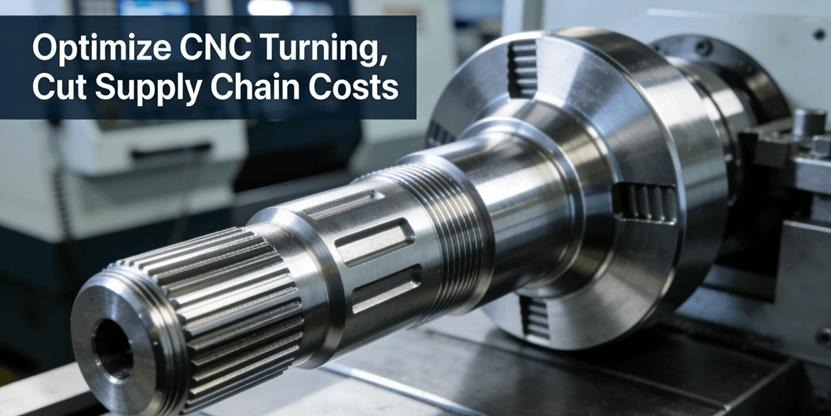
The global manufacturing industry is facing a trifecta of issues, including raw material cost fluctuations, supply chain instability, and increasing production costs. For engineering teams around the world, procuring precision parts can often involve issues of inconsistent part quality, delivery issues, and unexpected costs. The underlying cause of these issues often comes down to a traditional supply chain model that has not been sufficiently optimized for precision machining, causing unnecessary cost burdens for manufacturers.
In this article, the strategic importance of CNC Turning will be systematically analyzed, helping readers establish a complete framework to create a highly efficient model for procuring precision parts. The following five key issues will outline a complete optimization process for CNC Turning.
What is the pivotal role of CNC turning parts in modern manufacturing?
In the modern landscape of manufacturing, CNC Turning Parts form the basic building blocks that help attain superior accuracy, consistency, and efficiency. They are the unsung heroes in key industries like the automotive, aerospace, and medical device industries. For example, the performance of rotational symmetry parts like transmission shafts and pistons is critical to the overall efficiency of the power train, while the surface finish and biocompatibility of turned medical implants are critical to patient safety.
Studies by the International Society of Manufacturing Engineers (SME) have revealed that digital manufacturing is increasing the convergence of precision machining and supply chain management. CNC Turning technology, through digital programming, not only helps machine complex geometry in a single setup but also ensures micron-level precision stability in large-scale production. The continuous striving for perfection within the Engineering content makes the role of CNC Turning so vital as it bridges the gap between Prototyping and Production, and hence aids the entire Manufacturing industry in its shift towards Smart and Agile Manufacturing. The reliability of High-End products depends on the precision of the components that are turned.
Why has China become the global manufacturing center for CNC Turning Parts?
Today, China is undoubtedly the world’s centre for CNC turning parts china mainly because of its array of competitive advantages. The first and foremost advantage is a thriving industrial ecosystem that is tightly interconnected. From the provision of raw materials, and the production of machine tools to cutting tools, workholding and the inspection of services, industry networks enable highly efficient collaboration, which leads to a significant reduction in comprehensive procurement and logistics costs. In addition, the country has a great number of highly qualified and skilled workers, from technicians to engineers who can deliver anything from simple projects to highly complex machining ones. Indeed,
World Bank reports on manufacturing competitiveness show that China has an awesome combination of cost efficiency, infrastructure and market scale. To be strategic, programs such as Made in China 2025 focus on smart manufacturing and key processes, aiming to upgrade and standardize the whole industry. At the same time, global quality standards like ISO 9001, IATF 16949 and AS9100D have become very popular. The best CNC turning parts manufacturer in china not only gain these quality accreditations but also make these the core of their management systems, therefore guaranteeing that their products are always of the highest global standards. This way, China can produce excellent CNC Turning Parts and still maintain quality at a very reliable level.
How to evaluate and select reliable CNC turning parts manufacturers?
Choosing the appropriate partner is the key to success in procurement. A scientific assessment of the following five parameters will give a clear-cut judgment.
Technical Capability and Quality Certification
Technical competence is the foundation. The initial assessment is of the supplier’s machine park regarding its modernness, automation level, and use of specialized machinery. More important is their quality management system. Global certifications are the passport to entry.
l Foundational and Industry-Specific Standards:
ISO 9001 is a foundational standard, but IATF 16949 for the automotive industry or AS9100D for aerospace suggests a system that is capable of meeting very stringent traceability and reliability requirements.
l Process Control and Validation:
A good supplier for CNC turning parts manufacturer must have implemented Statistical Process Control (SPC) and provide Capability Process Index (CPK) information for critical dimensions, which validates process control. For additional information about the technical nuances, this guide is an authority for CNC turning parts.
Production Scale and Delivery Track Record
The manufacturing capacity should also match the project requirements. Assess the maximum throughput, order load, and contingency plans in place to ensure capacity constraints do not become issues. A supplier’s past record of on-time delivery, which can be gauged through their past customers, remains the best indicator of their project management and supply chain management skills.
Customer Service and Engineering Collaboration
An excellent manufacturing company should be a “solutions partner” rather than a “job shop.”It should have good front-end engineering support, including professional Design for Manufacturability (DFM) services to help optimize designs for lowest cost and fastest lead time. Responsiveness, communication skills, and problem-solving aptitude are significant factors to be considered for a successful and long-term relationship in CNC Precision Turning operations. For example, CNC Protolabs highlights the significance of direct communication with experts and free DFM services in their collaborative business model.
What are the unique advantages of aluminum in CNC turning?
Aluminum alloys are one of the most widely used materials in CNC Precision Turning due to their great combination of features. The first reason for this is the possibility to reduce weight. Since aluminum weighs only about one-third as much as steel, it can lower the inertia of moving parts and decrease the total weight of an assembly. This is certainly one of the most important factors for electric vehicles, aerospace, and consumer electronics. Besides that, aluminum has naturally good corrosion resistance and the component life can be further extended through surface treatments such as anodizing.
According to the technical reports by the Aluminum Association, the properties of the commonly used aluminum grades 6061 and 7075 are thoroughly described. As for machinability, aluminum is a real star: it needs less cutting force, does not wear the tool as much, and supports higher spindle speed and feed rate, which results in machining efficiency being up to three times greater than steel. This not only decreases the time of machining but also the machining cost per unit. Therefore, aluminum CNC turning parts are the best materials of choice in Engineering content that focus on weight reduction, performance, and cost-effectiveness. Drone frames, optical housings, precision-turned and finished aluminum parts are some examples where the excellent properties of aluminum perfectly match performance, aesthetics, and cost.
How to reasonably control the cost structure of CNC precision turning parts?
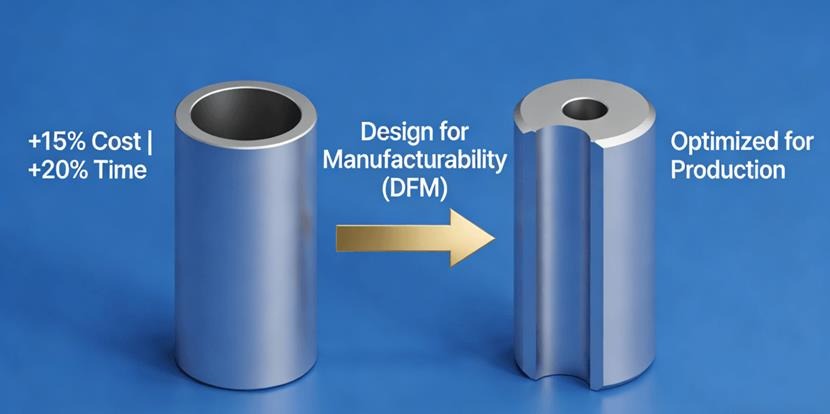
The effective management of the CNC precision turning parts price is not a bargaining issue but a systematic optimization based on a profound understanding of the cost drivers. The main cost drivers are material, machining time, tolerance/surface finish specifications, and order quantity.
Optimizing Design and Manufacturing Processes
The design is where most of the cost is defined. Early involvement with the manufacturer for DFM analysis is essential.
l Embrace Design Standardization:
Reduce special dimensions and non-standard features to take advantage of the supplier’s existing standard tooling and processes.
l Simplify Geometries:
Where functionally possible, reducing unnecessarily tight tolerances and avoiding difficult-to-machine features such as deep holes or thin walls can have a dramatic effect on cycle time and scrap.
Strategic Procurement and Process Refinement
With respect to the process, it is possible to reduce cycle time by optimizing parameters, utilizing high-performance tooling, and applying compound machining. In terms of procurement, it is possible to reduce costs by aggregating demand to realize economies of scale. A professional CNC turning services provider can frequently assist in reducing machining costs by 15-25% by applying expert DFM analysis.
Building a Transparent and Collaborative Partnership
The building of a long-term transparent partnership with a supplier is essential. This enables the sharing of production forecasts, which can be used to plan capacity and material requirements, thus providing more attractive pricing and delivery terms. And it is the management of these cost factors, as opposed to price, that will deliver the lowest total cost of ownership in the Manufacturing industry.
Conclusion
The impact of CNC Turning, as an essential technology in modern manufacturing, is not only limited to the quality of manufactured components, but it also influences the efficiency of the entire supply chain. By applying scientific approaches to supplier selection, material selection, and cost control, it is possible to realize substantial savings without compromising product quality. Request a professional CNC Turning solution quote today, and our engineering team will be happy to offer you a free DFM analysis and cost optimization suggestions to reduce your manufacturing costs by over 30%.
Author Bio
The author has 15 years of experience in the precision manufacturing industry, with a focus on research of CNC machining technology and supply chain optimization, and has offered manufacturing solution consulting services to several Global 500 companies.
FAQs
Q1: What is the maximum precision that can be obtained in CNC Turning?
A: With the latest CNC Turning technology, a diameter tolerance of 0.005mm and a surface finish of Ra 0.4m are achievable. High-precision machine tools and a temperature-controlled workshop environment enable us to meet the extremely strict requirements of the medical and aerospace sectors.
Q2: What are the benefits of aluminum CNC components over steel components?
A: Aluminum’s density is about one-third that of steel, which means it has a better strength-to-weight ratio. Also, aluminum demands less cutting force, causes less tool wear, and can be machined 2-3 times faster than steel, which makes it perfect for articles that require longevity and lightness.
Q3: How can the quality system of a CNC Turning supplier be checked?
A: Check the latest status of the supplier’s certification in ISO 9001 and IATF 16949, verify their calibration status of the inspection equipments, and request for the CPK values of typical parts and the quality control process documentation..
Q4: What are the main price differences between low-volume CNC machining and high-volume production?
A: The cost per part is influenced primarily by programming and setup time for low volumes. The production of large volumes piles up by the multitude of pieces that amortize the fixed costs whereas there is a possibility that the production of large volumes leads to the purchase of more efficient tools. Generally, the EOQ point occurs around 500-1000 pieces.
Q5: What is the typical turnaround time for sourcing CNC Turning Parts from China?
A: The creation of a prototype takes 3-5 working days, small-batch production needs 7-10 working days, and high-volume production requires 2-3 weeks. Cross-border shipping adds another 3-5 working days.
