
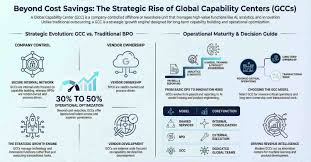
Digital transformation is no longer a technology-only agenda. In most industries, it now means redesigning operating models, modernising workflows, connecting data across functions, and scaling digital execution without disrupting ongoing business. That shift is one reason GCCs have moved from back-end support roles to more strategic positions in enterprise transformation.
India’s broader services economy helps explain that shift. The Government of India’s Economic Survey 2024–25 said services export growth accelerated to 12.8% in April–November FY25, up from 5.7% in FY24, and that computer services and business services account for around 70% of India’s services exports. That matters because digital transformation across industries increasingly depends on exactly these capabilities: technology delivery, business operations, analytics, and shared services execution.
As businesses expand digital programmes across markets and functions, many evaluate how leading gcc companies in shared services can support transformation through more structured execution, stronger cross-functional coordination, and scalable delivery models.
Why Digital Transformation Needs More Than Technology Investment
Many transformation programmes slow down not because the tools are wrong, but because execution is fragmented. A company may invest in cloud platforms, analytics systems, automation, or customer-facing digital tools, but still struggle to generate measurable outcomes if those systems are not embedded into day-to-day operations.
Transformation now cuts across multiple functions
Digital transformation no longer sits inside a single IT roadmap. It affects finance operations, supply chains, customer support, data governance, compliance workflows, internal reporting, and business planning. Once transformation touches several departments at once, the challenge becomes one of coordination and consistency rather than software deployment alone.
Operating model changes create execution pressure
Every major transformation programme changes how work gets done. Processes are redesigned, legacy tools are phased out, new workflows are introduced, and teams need to work across more connected systems. Without a structured delivery environment, these changes often create bottlenecks between functions.
Scale introduces a different kind of complexity
A pilot project may succeed within one team, but scaling the same model across business units or geographies is harder. Standardisation, governance, reporting logic, and user adoption all become more important at scale. This is where many businesses need an execution layer that is more stable than an ad hoc project model.
What GCC Companies Actually Contribute to Digital Transformation
GCCs support digital transformation by providing a more controlled environment for execution. Instead of treating transformation as a collection of isolated projects, they help businesses build operating continuity around those projects.
They centralise execution across connected functions
A GCC structure allows businesses to bring technology, analytics, business operations, and support processes into a more coordinated delivery model. That is especially useful when digital initiatives affect several teams at the same time and require aligned implementation rather than fragmented ownership.
They make transformation repeatable, not one-off
A common problem with transformation work is that it remains dependent on a small internal team or a short-term project push. GCCs help convert transformation into a repeatable model with defined workflows, reporting structures, and execution support, which makes long-term adoption easier.
They reduce friction between strategy and operations
Many transformation strategies are well designed at leadership level but lose momentum once they move into execution. GCCs often reduce that gap by handling the operational layer: workflow alignment, process support, data movement, issue tracking, and ongoing system coordination.
How GCC Companies Support Digital Transformation Across Industries
The role of GCCs becomes clearer when transformation is viewed through operational use cases rather than generic technology language. Their value usually appears in the way systems are implemented, supported, and scaled after the decision to transform has already been made.
Technology and product environments
In technology-led businesses, digital transformation often means faster release cycles, more integrated product systems, stronger data visibility, and lower dependence on fragmented tools.
- They support development and integration at scale: GCC teams can help coordinate product support, QA, platform integration, data pipelines, cloud operations, and technical documentation within one operating structure. That improves execution continuity across the product lifecycle.
- They improve post-implementation stability: A digital rollout is only useful if the system remains reliable after launch. GCCs often take on the monitoring, optimisation, and cross-team coordination needed to keep new systems stable under real business conditions.
Shared services and enterprise operations
Transformation in shared services is less about visible product innovation and more about process redesign. This includes finance operations, procurement workflows, reporting systems, HR processes, compliance controls, and service management.
- They help standardise workflows before automation: Automation only works well when the underlying process is clear. GCC teams can support process mapping, exception handling, controls alignment, and standard operating logic before automation is rolled out.
- They improve consistency across business units: Where different teams or regions have different ways of working, GCC-led models help build more uniform execution. That improves reporting consistency, process quality, and scalability.
- Data, analytics, and decision support: Digital transformation increasingly depends on data being reliable, accessible, and connected across systems.
- They help businesses operationalise analytics: It is one thing to build dashboards. It is another to ensure that data inputs, reporting logic, ownership, and refresh cycles are all managed properly. GCC teams often support that operational layer, which makes analytics more usable across functions.
- They improve decision speed through better data flow: When analytics systems are managed in a more centralised way, leaders can work with cleaner information and fewer reporting gaps. That improves planning, intervention speed, and performance tracking.
Customer operations and service delivery
For many businesses, transformation becomes visible first in customer-facing workflows: support systems, service coordination, response times, ticketing, and omnichannel operations.
- They improve consistency across channels: GCC teams can support more standardised processes across email, chat, platform support, and service operations, making customer interactions less fragmented.
- They reduce delays caused by disconnected systems: Where service teams rely on several tools that do not work well together, GCC-supported integration and workflow redesign can improve turnaround times and issue resolution quality.
Why India’s Digital Infrastructure Context Matters to GCC Growth
The broader digital environment in India also makes this model more relevant. It is easier for GCCs to support transformation at scale when the wider ecosystem supports digital delivery, connectivity, and business services growth.
The Telecom Regulatory Authority of India said that the country’s broadband subscriber base crossed 1 billion in November 2025, rising from 131.49 million in November 2015 to 100.37 crore in November 2025. That scale of digital connectivity matters because enterprise transformation increasingly depends on stable digital access, cloud-enabled workflows, data movement, and platform-based service models.
Connectivity now supports wider digital operating models
As digital infrastructure expands, businesses are better placed to run connected workflows across cities, teams, and operating functions. That strengthens the case for GCC-led transformation models that rely on integrated systems and distributed execution.
The ecosystem supports more than IT alone
This matters not just for software teams, but for analytics operations, digital support models, business process transformation, workflow automation, and shared services delivery. In other words, the infrastructure context strengthens the business case for GCCs as transformation enablers.
Where GCC Companies Add the Most Value During Transformation
Not every digital initiative needs the same kind of support. GCCs become particularly valuable when transformation work requires long-term coordination rather than a short implementation cycle.
Large multi-function transformation programmes
When finance, operations, technology, and customer workflows are all being modernised together, businesses often need a central execution model that can handle dependencies across teams.
Shared services redesign
Where businesses want to modernise internal service delivery through automation, data integration, or process standardisation, GCCs often provide the right execution environment.
Cross-market scaling
If a digital model needs to be rolled out across business units or geographies, GCCs can help maintain consistency in execution, reporting, and controls.
Ongoing optimisation after rollout
Transformation does not end at go-live. Systems need support, issues need resolution, and processes need refinement. GCCs often create value in this post-implementation phase because they can continue driving adoption and stability.
What Businesses Should Still Watch Carefully
GCC support improves execution, but it does not remove every risk. Businesses still need to plan transformation carefully.
- Poor process design will still create friction: If the underlying workflow is unclear, even a well-structured GCC model will struggle to create strong outcomes. Process clarity still matters.
- Governance must stay strong: As systems become more connected, accountability and reporting logic become more important. A transformation programme can lose discipline quickly if governance is weak.
- Adoption remains a business issue, not only a delivery issue: Teams need to use the new systems properly. Training, role clarity, and change management still matter even when GCC execution is strong.
Conclusion
GCCs support digital transformation not simply by adding delivery capacity, but by giving businesses a more structured way to execute transformation across functions. Their role is especially important when digital programmes involve process redesign, systems integration, analytics operations, shared services modernisation, and long-term optimisation.
That is why this model is becoming more relevant across industries. For businesses trying to connect technology investment with operational outcomes, understanding how leading gcc companies in shared services fit into the broader transformation landscape can help clarify how digital initiatives are scaled more consistently and sustained more effectively.
