
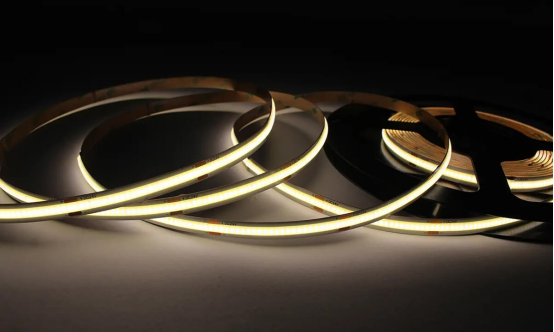
The global transition toward smart, energy-efficient, and human-centric lighting has placed linear solutions at the forefront of modern architecture. However, as the market saturates, the disparity between “commercial-grade” and “consumer-grade” products has widened. For procurement officers, lighting designers, and engineers, identifying elite LED strip light manufacturers is no longer a matter of price—it is a matter of risk management and long-term brand reputation.
In this analysis, we deconstruct the multifaceted layers of the LED strip manufacturing industry, providing you with the technical intelligence required to source with confidence.
Beyond the Surface: The Material Science of Linear Lighting
To understand why some LED strips fail within months while others last a decade, we must look at the micro-components. High-performance LED strip light manufacturers invest heavily in material science.
The PCB Metallurgy: Heat is the Silent Killer
Thermal management begins with the Printed Circuit Board (PCB). Most standard strips use a 1oz copper weight, which is insufficient for high-wattage applications.
- The Professional Standard: Leading factories utilize a 3oz/3oz double-sided rolled-annealed copper PCB. Rolled copper is more flexible and has better conductivity than electro-deposited (ED) copper, reducing the risk of micro-cracks during installation.
- Heat Dissipation: A thicker PCB acts as a heat sink. For every 10°C increase in junction temperature, the lifespan of an LED chip is effectively halved. Professional-grade manufacturers design their circuits to keep operating temperatures at least 20% below the chip’s maximum rating.
Phosphor Chemistry and Color Stability
The “white” light from an LED is actually blue light passed through a phosphor layer.
- The Degradation Issue: Low-quality phosphors degrade under heat and UV exposure, leading to the infamous “pink” or “green” shift after 1,000 hours.
- The Solution: Top-tier LED strip light manufacturers use premium Japanese or American phosphor brands. They also implement MacAdam Ellipse (SDCM) Step 3 binning, ensuring that color deviation is imperceptible to the human eye across thousands of meters of product.
Advanced Manufacturing Processes: Automation vs. Manual Labor
The reliability of a lighting system is a direct reflection of the factory’s production line.
SMT (Surface Mount Technology) Precision
The placement of thousands of tiny LEDs and resistors per hour requires extreme precision.
- High-Speed Mounters: Modern machines from brands like Yamaha or Panasonic ensure that components are centered perfectly. Offset components create uneven stress on solder joints, leading to “dead zones” when the strip is bent.
- Lead-Free Reflow Soldering: The temperature profile of the reflow oven is critical. Too hot, and the LED lenses become brittle; too cool, and the “cold solder” joints will fail under thermal expansion.
Encapsulation and Ingress Protection (IP)
Waterproofing is where many manufacturers fail. We can categorize the protection levels into three distinct engineering methods:
- Silicone Integrated Co-extrusion: This is the current “gold standard.” The PCB and the silicone sleeve are extruded simultaneously. This eliminates air gaps where moisture could condense and ensures uniform light output without yellowing.
- Nano-coating: For IP65 requirements where size is a constraint, advanced manufacturers use vacuum-deposited nano-coatings that protect against humidity without adding bulk.
- PU (Polyurethane) Potting: Used for heavy-duty underwater applications (IP68), PU offers better chemical resistance than standard silicone, though it requires a more complex curing process.
The “Invisible” Electronics: Resistors, ICs, and Constant Current
A common mistake in procurement is focusing only on the LEDs. However, the supporting electronics determine the strip’s stability.
Constant Voltage (CV) vs. Constant Current (CC)
- CV Strips: Traditional and cost-effective. However, they suffer from “Voltage Drop”—the end of a 10-meter run will be dimmer than the beginning.
- CC Strips (Internal IC): High-end LED strip light manufacturers now integrate Constant Current ICs directly onto the flexible PCB. This allows for runs of up to 20 or 30 meters with identical brightness from the first inch to the last. This is essential for large-scale architectural projects like skyscrapers or bridge lighting.
Flicker-Free Dimming
With the rise of video conferencing and high-speed cameras, “flicker” is a major concern. Professional manufacturers ensure their strips are compatible with high-frequency PWM (Pulse Width Modulation) or Amplitude Dimming drivers to ensure a Flicker-Free experience (IEEE 1789-2015 standard).
Rigorous Quality Control: The Laboratory Standards
When auditing LED strip light manufacturers, the presence of an in-house laboratory is the clearest indicator of quality. A guide would be incomplete without a checklist of mandatory tests:
Photometric Testing (The Integrating Sphere)
Every batch must be tested for:
- Luminous Efficacy: How many lumens are produced per watt? (Current high-end standards are 140-160lm/W).
- CRI and TM-30-15: Moving beyond CRI, the TM-30-15 metric provides a more accurate representation of color fidelity (Rf) and gamut (Rg), which is vital for retail and museum lighting.
Environmental Stress Testing
- Salt Spray Test: Essential for any manufacturer claiming their products can survive in coastal environments like Dubai or Florida.
- IK Rating (Impact Protection): For floor-recessed lighting or public spaces, the strip’s housing must withstand physical impact.
- UV Accelerated Weathering: This test simulates years of sunlight exposure in a few weeks to ensure the silicone jacket won’t turn yellow or crack.
Integrating Smart Technology: The 2026 Digital Shift
The lighting industry is no longer analog. The best LED strip light manufacturers are now “lighting solution providers” who understand digital protocols.
DMX512 and RDM
For dynamic facades and stage lighting, DMX512 remains the standard. Manufacturers must ensure their RGBW or Pixel-addressable (SPI) strips can handle high refresh rates without signal lag.
IoT and Wireless Protocols
From Casambi to Matter, the integration of wireless control is a primary requirement for smart homes and offices. A manufacturer that offers pre-paired kits or tested compatibility with these ecosystems significantly reduces on-site installation time.
Case Study: Solving the “Voltage Drop” in a 5-Star Hotel Project
To illustrate the importance of choosing the right partner, consider a recent luxury hotel project. The design called for 50-meter continuous runs of cove lighting in the lobby.
- The Problem: Initial samples from a mid-range supplier showed a 30% brightness drop after the first 5 meters and a visible color shift (more yellow) toward the end.
- The Solution provided by SignliteLED: By utilizing a 24V Constant Current IC design with a 3oz copper PCB, the project achieved perfectly uniform 3000K illumination across the entire perimeter with a single power feed.
- The Result: A 40% reduction in wiring complexity and a 100% match to the designer’s lux level requirements. This demonstrates why the technical expertise of LED strip light manufacturers is more valuable than a low unit price.
Global Compliance: Navigating UL, DLC, and ErP
Selling or installing lighting in international markets requires a deep understanding of local laws.
- North America (UL/ETL): Focuses heavily on fire safety and thermal performance.
- Europe (CE/RoHS/ErP): The new ErP (Energy-related Products) directive requires manufacturers to provide a “Flicker-Free” report and meet strict energy efficiency classes.
- Australia (SAA/C-Tick): Requires specific electromagnetic compatibility standards.
Working with LED strip light manufacturers who proactively maintain these certifications is a safeguard against legal liability and project delays at customs.
Strategic Procurement: Beyond the Transaction
The relationship with your manufacturer should be a partnership. Professional suppliers like SignliteLED offer:
- OEM/ODM Flexibility: The ability to customize PCB widths, CCTs, and cable lengths for specific architectural details.
- IES Files and Dialux Support: Providing the data files needed for lighting calculations.
- Sustainable Manufacturing: Documentation of recycled material use and carbon footprint reduction, which is increasingly required for LEED-certified buildings.
Conclusion: The Path Forward
As we move into 2026, the complexity of linear lighting will only increase. Choosing between various LED strip light manufacturers requires a balance of technical auditing, understanding of material science, and trust in their R&D capabilities.
A high-quality LED strip is not just a component; it is an investment in the visual comfort and safety of a space. By prioritizing 3oz PCBs, MacAdam Step 3 binning, and integrated IC technology, you ensure that your lighting designs remain as vibrant on day 2,000 as they were on day one.
For those ready to elevate their lighting projects with industrial-grade reliability, SignliteLED stands as a beacon of quality in the global market. Explore our comprehensive range of professional solutions and let us help you illuminate the future with precision and style.
