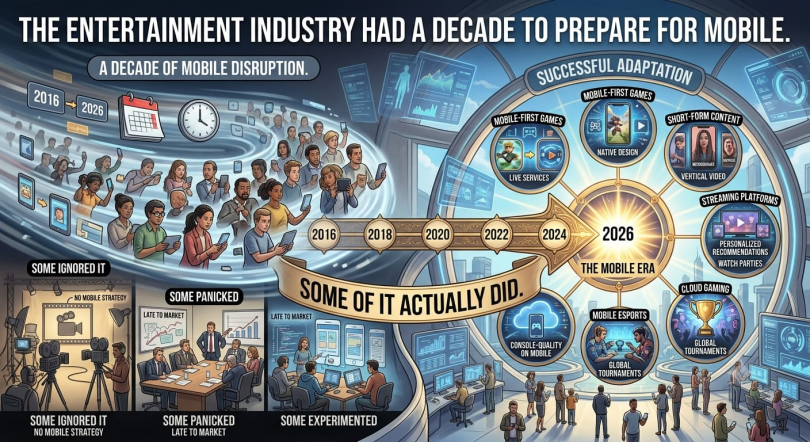

There’s a reliable pattern in how incumbent industries respond to platform shifts. First comes denial: the new thing is a novelty, not a threat. Then comes belated acknowledgment: the thing is real but the existing model can adapt to it. Then, for the incumbents who didn’t adapt fast enough, comes displacement by the companies that built for the new reality from the start. The entertainment industry’s relationship with mobile has followed this arc almost exactly, with some players reaching the adaptation stage before the displacement pressure arrived and others still catching up.
The companies that got there early didn’t necessarily see the future more clearly. They built for where their audience actually was rather than where it was supposed to be, and the audience happened to be on mobile. By the time the market data confirmed what behavioral observation had been suggesting for years, those companies had half a decade of mobile-native product development behind them. That head start compounds.
What distinguishes the companies that navigated this transition well from those that didn’t is less about technology choices than about how seriously they took mobile as a distinct context rather than a constrained version of an existing one.
Mobile Is a Context, Not a Screen Size
The most common mistake in mobile entertainment product development is treating mobile as a size problem: take what you have, make it smaller, and you’re done. That approach produces products that work on mobile in the sense that they load and display correctly, and fail on mobile in the sense that nobody actually enjoys using them.
Mobile is a context. It means divided attention, variable session length, frequent interruption, single-hand operation, lack of hover states, touch precision that’s fundamentally different from cursor precision, and an ambient competitive environment where the next app is a swipe away and patience is measured in seconds rather than minutes. Designing for that context requires starting from those constraints, not retrofitting for them.
The entertainment products that have performed best on mobile have all solved the attention problem specifically. Community forums and social platforms have contributed to the popularity of phrases like situs slot gacor, illustrating how player conversations increasingly shape online search trends. They deliver genuine value in fragments. A level that takes three minutes. A match that takes six. A story segment that can be consumed in the time between one stop and the next on a commute. Not because long experiences don’t exist on mobile, they do and they work, but because the entry experience can’t require the kind of upfront commitment that desktop-first products usually assumed.
The Touch Interface Relearning That Nobody Talks About
Decades of interface design accumulated around the mouse cursor. Hover states that revealed information. Right-click menus with secondary options. Precise clicks on small targets. Drag interactions with pixel-level accuracy. None of this translates to a finger on glass.
The mobile entertainment products that feel native aren’t just the ones that made buttons bigger. They’re the ones that rethought which interactions were necessary in the first place, removed the ones that were artifacts of desktop conventions, and built around gesture logic that’s intuitive on a touchscreen rather than a learned translation from mouse behavior. That design thinking takes time and iteration. The companies that invested in it early built institutional knowledge that new entrants can’t shortcut.
What the Infrastructure Race Actually Determined
The entertainment platform competition that played out over the past decade looks, from the outside, like a content competition: who had the best shows, the most games, the most varied library. The content was important. But the infrastructure decisions made alongside the content decisions are what actually determined which platforms were still standing and growing at the end of the decade.
Load time is the variable that separates platforms users think of as fast from ones they think of as slow, and the threshold for ‘fast’ has moved down over the decade as users calibrated to the best experiences they’d had. A platform that loaded acceptably in 2016 feels noticeably slow in 2024 because the reference point has shifted. Maintaining ‘fast’ required continuous infrastructure investment, not a one-time engineering effort.
Geographic distribution of content delivery infrastructure matters in ways that global platforms often underestimated in their initial rollout. A streaming platform that built primarily for North American latency and then expanded to Southeast Asia without corresponding infrastructure investment delivered a genuinely inferior experience to a significant portion of its audience. The CDN investment to fix that isn’t glamorous and doesn’t generate press. The audience experience of not having to wait while content buffers is, however, exactly what determines whether someone becomes a habitual user.
The Games That Defined What Mobile Entertainment Could Be
Gaming has been the most instructive category in mobile entertainment because it’s the one where quality signals are clearest and where the audience’s willingness to move on from bad experiences is most immediate. A game that isn’t fun loses players within the first session. No amount of marketing can reverse that if the product experience doesn’t justify continued engagement.
The titles that established what mobile gaming could achieve, Clash of Clans, Pokemon GO, PUBG Mobile, Genshin Impact, Candy Crush at scale, weren’t successful because they were technically impressive, though many were. They were successful because they solved specific problems that the mobile context created. They fit into real life rather than demanding time extracted from it. They offered genuine skill development and progression, not just the appearance of progress. They created social contexts that gave players reasons to return that weren’t dependent on new content.
Pokemon GO’s case is worth dwelling on because it demonstrated something that nobody had proven at scale before: that mobile technology could change where people physically went, not just what they did while sitting down. The game created real-world behavioral changes, community meetups at physical locations, people walking routes specifically to catch specific Pokemon, that had no precedent in entertainment product design. That’s a different relationship between entertainment and daily life than any previous platform had achieved.
Why Platform Accessibility Changed the Audience Composition
One of the least discussed but most consequential effects of mobile entertainment’s rise has been the demographic transformation of who considers themselves entertainment consumers of specific categories. Gaming is the clearest example. The gaming audience before smartphones was predominantly young, predominantly male, and concentrated in markets where gaming hardware was affordable and culturally normalized.
The smartphone dismantled those demographic filters one by one. No hardware purchase required beyond a phone most people already owned. No cultural context of being ‘a gamer’ required to pick up Candy Crush or Wordscapes. The audience that grew up around mobile gaming includes more women than men in most casual categories, more adults over 35 than under 25, and meaningful participation from markets that were previously marginal in the global gaming economy.
AI Personalization: The Gap Between Claim and Reality
Every entertainment platform at this point claims to personalize the experience. The claim ranges from accurate to essentially false depending on what’s actually behind it. Personalization that shows you more of what you’ve already consumed isn’t personalization, it’s echo chamber construction. Real personalization uses a richer signal set: not just what you engaged with but what you skipped, how long before you dropped off, what time of day you tend to engage with what kinds of content, and what the transition from one content type to another tells you about context.
The mobile context is actually better for personalization than desktop because mobile behavioral data is continuous in ways that desktop data isn’t. A phone is present throughout the day, which means usage patterns reveal not just preferences but contexts: what someone watches while commuting is different from what they watch before sleep, and both are different from what they engage with during a lunch break. Platforms that use those contextual signals to vary what they surface are delivering something meaningfully different from platforms that apply the same recommendation logic regardless of context.
The AI capability to do this well exists and has for several years. The gap between what’s technically possible and what most platforms actually deliver is primarily an organizational and prioritization gap rather than a technical one. The platforms that close that gap over the next several years will have a retention advantage that’s genuinely difficult to replicate quickly.
Security as Entertainment Infrastructure
The entertainment industry’s relationship with security has matured substantially over the past decade, partly through learning from painful incidents and partly through the maturation of security engineering as a discipline. A platform that handles payment information, stores personal data, and maintains long-term account relationships has different security obligations than one that serves anonymous sessions, and most entertainment platforms now handle all three.
Biometric authentication has been the most user-visible security improvement on mobile, and it’s a case study in how security improvements can actually improve rather than degrade user experience. Face ID and fingerprint authentication are faster than password entry, more secure than most passwords people actually choose, and have near-universal adoption among users who have the option. That combination is rare in security engineering, where improvements typically involve tradeoffs.
Fraud detection has become more sophisticated as the attack surface has expanded. In-game economies and virtual currency systems have attracted fraudulent activity that didn’t exist when entertainment transactions were simpler. The platforms that maintain competitive integrity and financial security in these environments build trust that accumulates as a meaningful competitive asset.
Where the Next Decade of Investment Is Actually Going
The investment directions in mobile entertainment infrastructure for the next several years are fairly visible if you look at where current limitations concentrate. Mid-range device performance is the most significant open problem: the experience gap between a flagship device and a two-year-old mid-range Android is still wide enough to meaningfully affect what entertainment experiences are viable for a large portion of the global audience.
Platforms like Markas Gacor represent the kind of responsive, cross-device approach that the next generation of mobile entertainment infrastructure is converging toward: consistent performance regardless of hardware tier, browser-based accessibility that removes installation friction, and design discipline that serves the actual context of mobile use rather than a desktop experience adapted for smaller screens. That combination, rather than any single technology feature, defines what mobile-first actually looks like when it’s done with full commitment.
The entertainment companies positioned best for the next decade aren’t necessarily the ones with the most content or the most users today. They’re the ones that have built mobile technology infrastructure capable of serving the full diversity of the mobile audience, across the full range of device quality, across the full range of geographic markets where that audience lives. That’s a different kind of competitive moat than content libraries or brand recognition, and it’s considerably harder to replicate quickly.